Mosque PA & Announcement Systems: A Complete Guide
A mosque PA and announcement system lets you play the adhan, make live or scheduled announcements, and raise alerts across your masjid's speakers — ideally controlled from your phone. Modern systems do far more than a microphone and amplifier: they schedule audio, split the building into zones, and handle emergencies. This guide explains what to look for.
What does a modern mosque announcement system do?
A modern mosque announcement system automates the adhan and iqamah, plays scheduled and spoken announcements through the masjid's existing speakers, allows live push-to-talk from a phone, splits the building into zones, and overrides everything for an emergency. Each capability and what it means in practice is below.
| Capability | What it means for your masjid |
|---|---|
| Automated adhan | Plays the call to prayer on schedule for your location |
| Scheduled announcements | Reminders, notices and messages at set times, automatically |
| Live announcements (PTT) | Speak to the whole masjid from a mic or phone |
| Zones | Send audio to specific areas (main hall, sisters' area, car park) |
| Emergency alerts | Fire/evacuation voice alerts, at priority volume |
| Remote control | Manage everything from a phone or web dashboard |
| Phone/messaging alerts | Notify committee members instantly |
How does a smart announcement system differ from a traditional PA?
A traditional setup is a microphone, mixer, amplifier and speakers — fine for a live khutbah, but it can't schedule anything, can't run the adhan by itself, and needs someone physically present. A smart system adds a small always-on controller that:
- runs the prayer-time schedule and triggers the adhan automatically;
- plays scheduled or text-to-speech announcements (English voice) without recordings;
- lets committee members control it remotely from anywhere;
- can raise emergency alerts and notify phones.
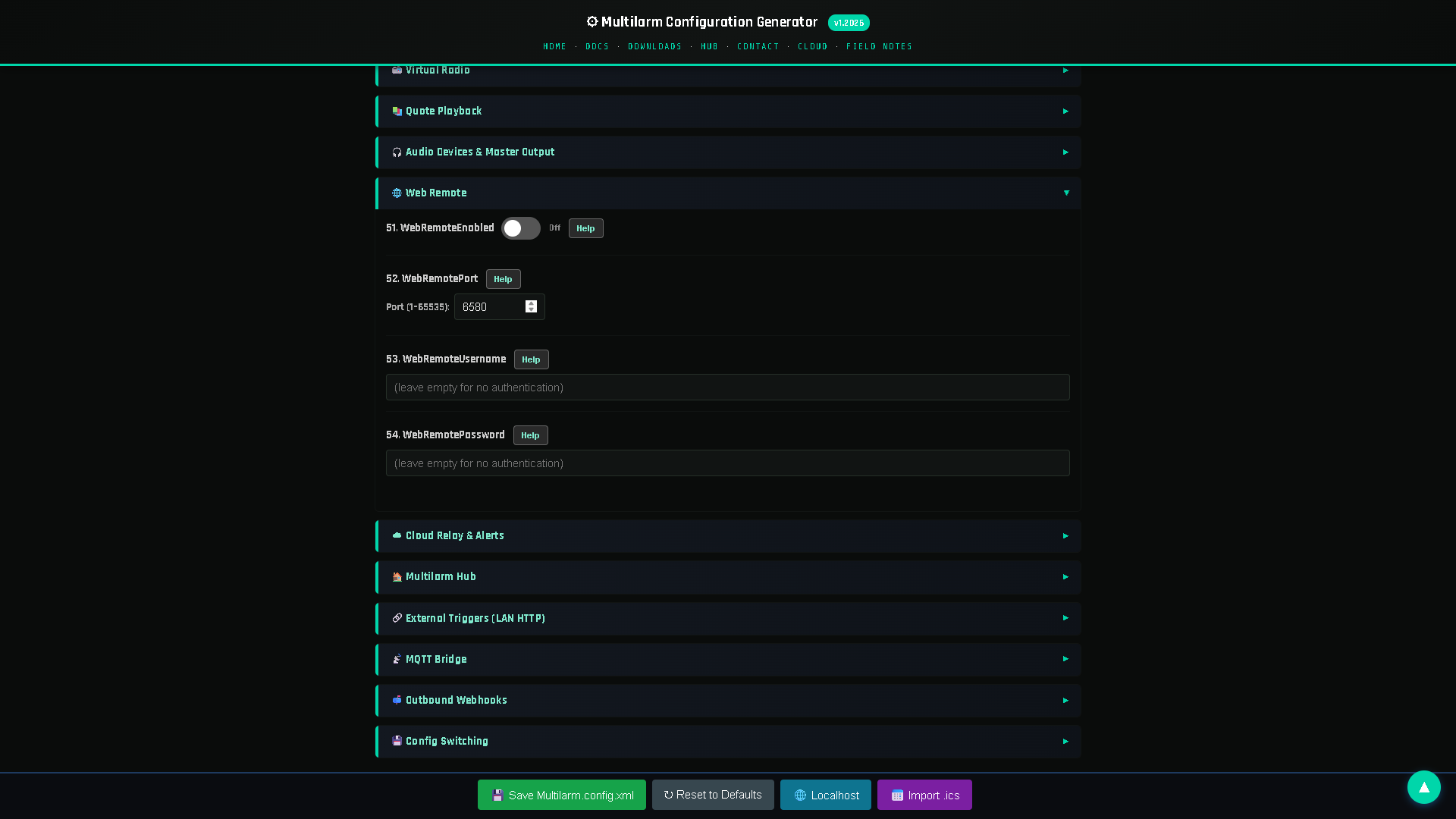
Multilarm is an example: it runs on a low-cost Raspberry Pi, connects to your existing amplifier and speakers, and is controlled from a web dashboard or an Android app.
Which features should you look for?
Six things separate a system that will still be working in five years from one that will not: reliable all-year scheduling, announcements that can be scheduled as well as spoken live, zone control, a clear emergency path, remote control that needs no port forwarding, and configuration you can back up and restore. Each is expanded below.
1. Reliable scheduling
The core job. Prayer times must update automatically for your location and calculation method, all year. See our adhan automation guide.
2. Zones
Can you send different audio to different areas? Useful for announcements that shouldn't interrupt a class, or for reaching outdoor areas.
3. Live passthrough (push-to-talk)
Can a committee member make a live announcement from a microphone or their phone, without walking to a control room?
4. Emergency handling
Does it support fire/evacuation voice alerts that override normal audio at a set volume? Can it send emergency alerts to phones? This is increasingly expected for public buildings.
5. Remote management
Cloud control means the person managing audio doesn't have to be in the building. Look for a phone app or web dashboard.
6. No vendor lock-in
Systems built on standard hardware (like a Raspberry Pi) using your existing speakers avoid expensive proprietary boxes and are cheaper to maintain.
What does it cost?
Costs vary, but the smart-controller approach is deliberately affordable: you reuse your existing amplifier and speakers and add a low-cost controller and software. Avoid systems that require ripping out your current audio or buying a single expensive proprietary unit. Ask any vendor for a clear, one-off or transparent price and a free live demo before committing.
How should you choose between systems?
Work down the checklist below with the specific masjid in mind. Anything a supplier cannot demonstrate on request should be treated as absent rather than promised, and any item that needs somebody physically present every day is a job nobody will keep doing.
- Automates the adhan accurately for your location, all year
- Schedules announcements and supports live push-to-talk
- Supports zones if your building needs them
- Handles emergency/evacuation alerts
- Controlled remotely from phone/web
- Works with your existing speakers (no lock-in)
- Offers training/support and a free demo
Try before you decide
See a full mosque announcement system live — free demo No installation needed; explore the dashboard and hear how it works.
FAQ
Can I keep my existing speakers and amplifier?
Yes — a good system connects to your current audio. You shouldn't need to replace speakers.
Can we make live announcements as well as scheduled ones?
Yes, with push-to-talk you can speak live from a mic or phone, in addition to automated audio.
Are announcements spoken in Arabic?
Automated text-to-speech announcements are in English. The adhan is a pre-recorded human recitation. You can also play your own pre-recorded audio in any language.
Can it alert us in an emergency?
Yes — modern systems raise evacuation voice alerts and can notify committee phones instantly.
Do we need someone technical to run it?
No. It's managed from a simple dashboard or phone app, with support and training available.
Multilarm is a Raspberry-Pi-based announcement, prayer-time and emergency-alert system for mosques and facilities. Try the free live demo »